Home Pricing About Us Contact

Imagine cutting a diamond with a plastic knife. That sounds absurd, right? Yet, millions of designers try to create masterpieces in Photoshop every day without truly understanding the powerhouse sitting on their left—the Toolbar.

Mastering the Photoshop Toolbar isn’t just about knowing what each icon does; it’s about transforming your workflow from a sluggish, frustrating hunt for buttons into a fluid, intuitive creative dance. With over 70 tools tucked into that slim panel, the difference between a professional and an amateur lies in efficiency.

In this professional guide, we will decode every corner of the Photoshop Tools Toolbar. You’ll learn how to navigate hidden tools, master essential shortcuts for precision editing, and customize your space to save hours of work. For a complete reference, Adobe’s official Photoshop tool gallery is an excellent resource.

🎯 Stop searching for tools; start finishing projects. If photo editing takes too long, let our experts handle the heavy lifting. Get a Free Trial on Background Removal today and reclaim your editing time!


What is the Photoshop Toolbar? Understanding Your Command Center

The Photoshop Toolbar (sometimes called the Tools panel) is the vertical column of icons located on the far left of your default workspace. Think of it as the steering wheel of your car; you can drive without knowing every button, but you will never win a race.

Adobe designs the toolbar to contain every action you perform on your canvas. From moving elements to painting details, the toolbar gives you instant access to the software’s core functions. If you ever want to dive deeper into workspace customization, the Adobe Help Center offers detailed guidance.

Single vs. Double Column View

Photoshop starts the toolbar as a long, single column. However, you can expand it into a shorter, double-column layout. Click the double arrows at the very top of the toolbar to switch views. Double-column mode allows you to see more tools at once without scrolling endlessly. Click the double arrows again to revert to the single-column view.

The Psychology Behind the Layout

Adobe organizes the toolbar logically, grouping functions by workflow. Here is the standard flow:

  1. Selection & Move Tools (Top): You select the object.
  2. Crop & Slice Tools: You frame the canvas.
  3. Measurement & Color Picker: You analyze the image.
  4. Retouching & Painting Tools: You edit and enhance.
  5. Drawing & Type Tools: You add elements.
  6. Navigation Tools (Bottom): You zoom and pan.

This layout mirrors the natural progression of editing: Select, Modify, Refine, Navigate.

Hidden Tools: The Triangle Secret

Here is a crucial point many beginners miss: Most toolbar spots hold more than one tool. Look for a small triangle in the bottom-right corner of an icon. Click and hold on the icon, or right-click (Windows) or Control-click (Mac). A fly-out menu reveals all the additional tools grouped there.


Section 1: Selection and Crop Tools

Before you can edit a photo, you must tell Photoshop where to work. That’s the job of the Selection and Crop tools.

The Move Tool (V): The Foundation of Workflow

The Move Tool is the topmost icon (a cursor with a crosshair). You cannot run Photoshop without it. It allows you to reposition layers, selections, and guides across your canvas.

  • Pro Tip: Hold Ctrl (Windows) or Cmd (Mac) while using any other tool to temporarily access the Move Tool. This keeps your workflow fluid without constantly clicking the toolbar.

Marquee Tools (M): Geometric Accuracy

The Marquee Tool draws straight-edged or circular selections. The default is the Rectangular Marquee.

  • Elliptical Marquee: Ideal for selecting eyes or planets.
  • Single Row/Column: Selects a 1-pixel line across the canvas (useful for creating patterns).
  • Pro Tip: Hold Shift while dragging to create a perfect square or circle.

Lasso Tools (L): Freehand Freedom

When you need to select something organic (like a person’s hair or a flower), the Lasso family is your best friend.

  • Standard Lasso: Draw freehand selection.
  • Polygonal Lasso: Click points to create straight-edged polygons.
  • Magnetic Lasso: The AI-powered option. It snaps to the edges of an object as you trace it, based on color contrast.

Quick Selection & Magic Wand (W): Color-Based Selections

The Quick Selection tool acts like a brush; you paint over an area, and Photoshop automatically finds the edges of similar tones and colors.
The Magic Wand selects all contiguous pixels sharing a similar color value with a single click. It is wildly effective for removing solid-color backgrounds like white walls or blue skies. For tricky backgrounds, combining the Magic Wand with layer masks is a pro technique. Photoshop Cafe’s tutorial on selections explains this in depth.

Crop Tool (C): Composition King

The Crop Tool does more than just trim edges. The latest updates (2025–2026) support panning and zooming for more precise framing.

  • Overlays: Photoshop offers grid overlays (like the Rule of Thirds) to help you balance your composition.
  • Straighten: Use the ruler tool inside the crop menu to drag along a horizon line and automatically correct tilted photos.

Section 2: Retouching and Painting Tools

This section holds the secret sauce for professional photography. Whether you are removing a pimple or painting a sunset, these tools define your digital art.

Spot Healing Brush (J): The Blemish Remover

This is the go-to tool for dust spots, wrinkles, and pimples. It automatically samples the texture around the blemish and blends it seamlessly.

Clone Stamp Tool (S): Pixel-Perfect Duplication

The Clone Stamp allows you to sample one area of an image (by holding Alt + click) and paint it elsewhere. Use this for removing complex objects (like a trash can from a beach photo) that the Healing Brush cannot handle.

Brush Tool (B): Your Digital Paintbrush

The Brush Tool is the most versatile tool in the software. You can change its hardnessopacity, and flow.

  • Increasing Brush Size: Quickly press ] to increase size, [ to decrease.
  • Hardness: Use Shift + [ or Shift + ] to adjust hardness.

Gradient Tool (G): Smooth Color Transitions

Gradients blend two or more colors. The default is a black-to-white gradient. However, you can access the Gradient Editor to create custom multi-color blends widely used in background design and lighting effects.

History Brush (Y): The Time Machine

Imagine messing up a painting but being able to brush the “old” version back to life. The History Brush paints from a previous state of your image. If you blur an image but want to restore the eyes sharply, you set the history state to “before blur” and paint the sharpness back in.

🎨 Too many tools to master? Focus on creativity, not complex workflows. Let our professionals handle Image Masking for perfect extractions while you design the big picture.


Section 3: Drawing, Type & Navigation Tools

Vector paths, text, and zooming—these tools bridge the gap between photo editing and graphic design.

Pen Tool (P): The Ultimate Precision Tool

The Pen Tool is arguably the most difficult tool to learn, yet the most rewarding. It creates paths (vector lines) that remain sharp no matter how much you zoom in.

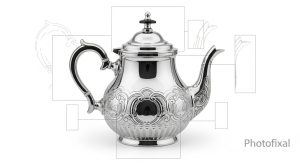
  • Why use it? For professional product clipping paths. The Pen Tool allows you to cut out a product with mathematically perfect curves, resulting in a clean “white background” effect without jagged edges.
  • Pro Tip: Use Alt (Opt) to break the direction handles to create sharp corners.

For a step-by-step walkthrough, the Adobe Pen Tool practice guide is invaluable.

Type Tools (T): Adding Text

Click the canvas to start typing. The Horizontal Type Tool is standard, but the Vertical Type Tool writes text top-to-bottom, which is popular for East Asian typography and side spines.

Hand Tool (H) & Zoom Tool (Z): Navigation

The Zoom Tool magnifies your image. Press Alt (Opt) to zoom out.
The Hand Tool pans around the image when you are zoomed in. The most efficient way to use these? Hold the Spacebar to temporarily activate the Hand Tool. Hold Ctrl + Spacebar (Cmd + Spacebar) to zoom in without switching tools.


How to Customize the Photoshop Toolbar (Save Hours)

You do not have to keep tools you never use. Photoshop allows you to strip the toolbar down to only the essentials.

Step-by-Step Customization

  1. Go to the top menu and select Edit > Toolbar (Photoshop > Settings > Toolbar on Mac).
  2. A dialog box opens with two columns: Toolbar (visible) and Extra Tools (hidden).
  3. Drag any unused tool from the left column to the right column to hide it.
  4. Click Done.
  5. Adding Tools: If you cannot find the “Content-Aware Tracing Tool” or newer AI tools, go back to this menu, click “Restore Defaults,” or drag them from the Extra column back into the main toolbar.

⚡ Speed is everything in eCommerce. Stop fighting the Pen Tool. Outsource your product editing with our Multi-Clipping Path Service for consistent results across hundreds of images instantly.


2026 Updates: What’s New in the Toolbar?

Adobe constantly rolls out updates. Here is what is hot in the Photoshop Toolbar for 2026:

  • Enhanced Contextual Task Bar: It now puts the specific tools you need for your current layer (like “Remove Background” or “Refine Edge”) right in your sightline.
  • Dynamic Text: A new feature allowing text to adapt automatically to shapes and paths like circles and arches, accessible via the task bar.
  • Clarity and Dehaze Adjustments: New sliders integrated into adjustment layers to sharpen images and remove fog without complex layer masks.
  • Crop Tool Upgrades: Panning and zooming support makes precise framing easier than ever.

Keep up with official changes by visiting the Adobe Photoshop features blog.


Workflow Hacks: Keyboard Shortcuts Every Pro Uses

Clicking the toolbar slows you down. Memorize these keys to keep your hands on the keyboard.

ToolWindows ShortcutMac Shortcut
Move ToolVV
Marquee ToolsMM
Lasso ToolsLL
Crop ToolCC
Brush ToolBB
Spot Healing BrushJJ
Clone StampSS
History BrushYY
Eraser ToolEE
Gradient / Paint BucketGG
Blur / Sharpen / SmudgeR (press Shift+R to cycle)R (press Shift+R to cycle)
Pen ToolPP
Type ToolTT
Path SelectionAA
Rectangle / Shape ToolsUU
Hand ToolH (or Spacebar)H (or Spacebar)
Zoom ToolZZ
Default Fore/BackgroundDD
Swap Fore/BackgroundXX
Edit in Quick MaskQQ
Screen ModesFF

For a complete list of Photoshop shortcuts, the Adobe keyboard shortcuts guide is a must-bookmark.

💡 Need a flawless product presentation? A simple shadow can double your conversion rate. Get Professional Drop Shadow Services to make your products pop off the page.


FAQ: Solving Your Photoshop Toolbar Mysteries

1. How do I recover a missing Toolbar in Photoshop?
If your Toolbar disappears, go to the Window menu in the top navigation and select Tools. A checkmark will appear next to it, and the toolbar will snap back to the left side of your screen.

2. Why do some tools in my toolbar have a small triangle?
The small triangle indicates a fly-out menu. It means multiple tools share that single icon. Click and hold the icon to reveal the hidden options, such as the Elliptical Marquee hiding under the Rectangular Marquee.

3. How do I permanently remove tools I never use?
You cannot “delete” them, but you can hide them. Go to Edit > Toolbar. Drag tools you want to hide from the left column (Toolbar) to the right column (Extra Tools). This cleans up your workspace perfectly.

4. What is the difference between the Brush Tool and the Pencil Tool?
The Brush Tool creates soft, anti-aliased edges (pixels blend into the background). The Pencil Tool creates sharp, hard edges with no blending. Use the Pencil for pixel art, not for photo retouching.

5. Why is my Pen Tool drawing a shape instead of a path?
You likely have the wrong setting selected in the top options bar. Ensure the drop-down menu is set to Path (the middle icon), not “Shape” (the left icon) or “Pixels” (the right icon).

6. How can I access the Content-Aware Fill tool?
It is not a default toolbar icon in all workspaces. You can find it under Edit > Content-Aware Fill. Alternatively, use the Lasso to select an area, right-click, and choose Fill > Content-Aware.

7. Can I reset the toolbar to default settings?
Yes. Open the Customize Toolbar dialog (Edit > Toolbar). Click the Restore Defaults button at the top right. This instantly reverts all hidden tools back to the original layout.

🎨 Ready to perfect every skin tone and wrinkle? High-end portraits require surgical precision. Use our Headshot Retouching Service to deliver flawless corporate or personal branding photos.


Conclusion: From Overwhelmed to Master

The Photoshop Toolbar is intimidating, but it is also beautifully logical. You now know that the selection tools live at the top, the healing tools in the middle, and the navigation at the bottom.

Stop memorizing every icon. Instead, focus on mastering five core tools: The Move Tool (V), Brush (B), Spot Healing Brush (J), Pen Tool (P), and Crop (C). When you master these five, you handle over 80% of professional editing tasks.

However, technology should serve your vision, not enslave you to the clock. If you are spending hours cutting out hair, removing complex backgrounds, or masking fine details, you are burning billable hours.

📸 Let technology serve you. Don’t let repetitive editing kill your passion. Get a Free Quote for Photo Retouching and send your images to our pros while you focus on landing the next big client.

Photofixal

We are a premier image post-production company specializing in professional shadow creation and product image editing services by expert human editors. Trusted by e-commerce businesses, product brands, and photographers worldwide.

Services

Company

Contact

info@photofixal.com
+880 1714 420630
Dhaka, Bangladesh

© 2026 Photofixal. All rights reserved.

Privacy Policy | Terms of Service |