Home Pricing About Us Contact

What Is Depth of Field in Photography? Aperture, Focus & Bokeh Guide

Master the Most Powerful Creative Tool in Your Camera Bag

Depth of field shapes the mood, focus, and storytelling power of every photograph you take. Whether you’re chasing dreamy portrait blur or razor-sharp landscape detail, understanding this concept changes how you see through your viewfinder forever. This guide breaks down what depth of field really means, what controls it, and how you can master it on your very next shoot.

Photographers often call depth of field the “invisible director” of an image. It tells viewers exactly where to look, which elements matter, and which fade into beautiful softness. Once you grasp how it works, you’ll stop relying on automatic modes and start crafting photos with intention.

📸 Ready to make your photos look professionally polished? Our expert photo retouching services sharpen subjects, smooth backgrounds, and enhance depth so every shot tells the story you intended.


What Is Depth of Field in Photography?

The Simple Definition Every Beginner Should Know

Depth of field (DoF) refers to the zone in your photograph that appears acceptably sharp, measured from the closest point in focus to the farthest. Your camera technically focuses on only one precise plane, but our eyes accept a gradual zone around that plane as “sharp enough.”

Think of it as a window of clarity inside your frame. Everything inside that window looks crisp. Everything outside it slowly melts into blur, also known as bokeh.

Photographers usually describe depth of field in two ways:

  • Shallow depth of field — A narrow slice of the scene is sharp, while the rest blurs softly (popular in portraits, food, and product shots).
  • Deep depth of field — A wide range of the scene stays sharp, from foreground to background (ideal for landscapes, architecture, and group photos).

According to Adobe’s photography guide, shallow DoF helps photographers isolate subjects and direct attention with surgical precision. Deep DoF, on the other hand, keeps every layer of a scene legible.

Why Depth of Field Matters Creatively

Depth of field directly controls visual hierarchy. When you blur the background, you tell the viewer’s brain, “Look here first.” When everything stays sharp, you invite exploration across the entire frame. This single creative choice often separates amateur snapshots from professional images.


The Science Behind Depth of Field: Circle of Confusion

Why “Acceptably Sharp” Isn’t Just a Vague Term

Behind every depth of field decision sits a real optical concept called the circle of confusion (CoC). When light from a single point passes through your lens, it should converge to a perfect pinpoint on the sensor. Sometimes, however, it spreads into a tiny disc instead.

If that disc stays smaller than what the human eye can detect at normal viewing distance, the point still looks sharp. The moment it grows larger, your eye registers the area as blurred. The range where points remain “small enough” defines your depth of field.

Key points about the circle of confusion:

  • It depends on sensor size, print size, and typical viewing distance.
  • A standard CoC value for full-frame cameras is around 0.03 mm.
  • Smaller sensors require a smaller CoC, which affects DoF calculations.

Wikipedia’s overview of the circle of confusion explains how this single measurement quietly powers every depth of field chart, calculator, and hyperfocal distance reading you’ll ever use.


The 4 Factors That Control Depth of Field

Four main variables decide how shallow or deep your depth of field will be. Master these, and you control the look of every photograph you make.

1. Aperture (F-Stop)

Aperture sits at the heart of DoF control. The aperture is the adjustable opening inside your lens, measured in f-stops (f/1.4, f/2.8, f/8, f/16, etc.).

  • Wide aperture (small f-number like f/1.4 or f/2) → very shallow depth of field, creamy background blur.
  • Narrow aperture (large f-number like f/11 or f/16) → deep depth of field, sharp from front to back.

Remember the counterintuitive logic: smaller f-number equals bigger opening equals shallower DoF.

2. Camera-to-Subject Distance

The closer you stand to your subject, the shallower your depth of field becomes — even at the same aperture. This is why macro photographers constantly fight to keep insects or jewelry fully in focus.

  • Move closer → DoF shrinks.
  • Move farther → DoF expands.

3. Focal Length of the Lens

Longer focal lengths appear to compress depth of field, while wide-angle lenses look like they capture more in focus. A 200mm telephoto throws backgrounds into dramatic blur, whereas a 24mm wide-angle keeps far more of a scene sharp.

✨ Want product photos with perfectly blurred backgrounds and razor-sharp edges? Try our precision clipping path service to isolate subjects and recreate that high-end depth-of-field look in post-production.

4. Sensor Size

Sensor size influences DoF indirectly. To frame the same shot, a smaller-sensor camera (like Micro Four Thirds or APS-C) must either step back or use a shorter focal length. Both adjustments increase depth of field compared to a full-frame camera shooting the same composition.

That’s why full-frame cameras enjoy a reputation for “creamier” background blur. The PhotoPills DoF calculator lets you simulate these differences across sensor formats before you even pick up the camera.


Shallow vs. Deep Depth of Field: Which Should You Choose?

When Shallow Depth of Field Shines

Shallow DoF works best when you want a single subject to dominate the frame. Use it for:

  • Portrait photography — soft, flattering background blur that flatters skin and features.
  • Product photography — isolate one item against creamy backgrounds.
  • Food photography — guide the eye to the hero ingredient.
  • Wildlife close-ups — separate an animal from busy foliage.
  • Wedding details — make rings, flowers, and decor pop.

When Deep Depth of Field Wins

Deep DoF helps when every layer of the scene carries meaning. Reach for it in:

  • Landscape photography — keep foreground rocks and distant mountains equally sharp.
  • Architecture and real estate — show entire interiors crisply.
  • Group photos — make sure nobody falls out of focus.
  • Street photography — capture multiple stories happening at different distances.
  • Astrophotography — render foreground and stars together with clarity.

Different camera systems excel at different styles too. You can explore which gear matches your creative vision in this breakdown of the top 10 popular camera brands, which compares strengths across portrait, landscape, and hybrid shooting.


Hyperfocal Distance: The Landscape Photographer’s Secret Weapon

Maximize Sharpness from Foreground to Infinity

The hyperfocal distance is the closest focusing distance that still keeps objects at infinity acceptably sharp. Focus there, and your depth of field stretches from roughly half that distance all the way to the horizon.

Steps to use hyperfocal distance:

  • Set your aperture (commonly f/8 to f/16 for landscapes).
  • Note your focal length and sensor size.
  • Use a chart, app, or PhotoPills calculator to find the hyperfocal distance.
  • Focus manually at that distance.
  • Shoot — your entire scene should now be sharp.

Landscape pros rely on this trick to avoid the rookie mistake of focusing on infinity and losing foreground detail.


How Aperture, Shutter Speed, and ISO Interact with DoF

Aperture doesn’t operate in isolation. When you change it, you must rebalance the exposure triangle:

  • Open the aperture (shallower DoF) → reduce shutter speed or lower ISO to avoid overexposure.
  • Close the aperture (deeper DoF) → increase shutter speed slowly, or raise ISO to keep brightness consistent.

In low light, shooting at f/16 for deep DoF can force long exposures, so a tripod becomes essential. Conversely, shooting wide open at f/1.4 in bright sunlight may require a fast shutter or an ND filter to prevent blown highlights.

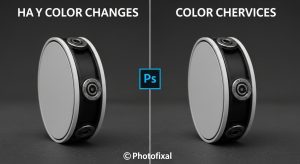
🎨 Need a color-corrected image with cinematic mood? Our professional color change service refines tones, balances exposure, and enhances depth so your photos feel intentional and polished.


Practical Tips to Master Depth of Field on Any Camera

Beginner-Friendly Techniques That Work Immediately

  • Switch to Aperture Priority mode (A or Av) — you control DoF while the camera handles shutter speed.
  • Use the depth-of-field preview button — most DSLRs let you see actual DoF before shooting.
  • Trust the LCD or EVF — review the shot, zoom in 100%, and adjust as needed.
  • Practice with a single subject — shoot the same scene at f/1.8, f/4, f/8, and f/16 to see the differences.
  • Mind your focus point — single-point AF helps you place sharpness exactly where you want it.

Advanced Tricks for Professional Results

  • Focus stacking — combine multiple shots focused at different distances for sharpness front-to-back, perfect for macro and landscapes.
  • Tilt-shift lenses — control the plane of focus to break standard DoF rules.
  • Subject layering — place elements at intentional distances to maximize separation.
  • Background distance — moving your subject farther from the background increases the blur effect even at the same aperture.

Many photographers also rely on post-production to refine separation between subject and background, especially in e-commerce and editorial work.

🛍️ Selling products online? Our ghost mannequin editing service gives apparel that clean, depth-of-field-style look buyers expect on Amazon, Shopify, and luxury storefronts.


Common Depth of Field Mistakes (and How to Fix Them)

Even experienced photographers slip into these traps. Watch out for:

  • Shooting wide open for everything — f/1.4 looks beautiful, but it often misses the eye in portraits. Step up to f/2.8 or f/4 for better keeper rates.
  • Forgetting the focus point — auto-area AF may lock onto the nearest subject instead of the one you want.
  • Ignoring diffraction — beyond f/16, image quality drops because light bends around the aperture blades.
  • Mistaking blur for shallow DoF — motion blur and out-of-focus blur look different. Check your shutter speed.
  • Underestimating background distance — a close background blurs less than a far one, regardless of aperture.

According to B&H Photo’s exposure guide, most beginners overcorrect with extreme apertures when small adjustments often deliver better results.


How Editing Enhances Depth of Field

Post-processing can amplify or even simulate depth of field when shooting conditions limit you. Skilled retouchers blur backgrounds selectively, sharpen subjects, and rebuild separation between layers. Modern software like Photoshop, Lightroom, and Capture One offers tools such as lens blur filters, radial masks, and AI-driven subject selection.

Common DoF-enhancing edits include:

  • Selective Gaussian blur to deepen background softness.
  • Subject sharpening with frequency separation for portraits.
  • Background extraction and replacement for cleaner separation.
  • Skin and eye retouching that draws attention to the focus point.

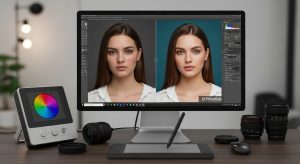
👤 Need flawless portraits with magazine-grade focus on the eyes? Try our headshot retouching service — we sharpen eyes, refine skin, and enhance natural depth for stunning results.


Frequently Asked Questions About Depth of Field

1. What does depth of field mean in simple terms?

Depth of field is the part of your photo that looks sharp, measured from the nearest in-focus point to the farthest. Outside this zone, the image gradually becomes blurry.

2. Which aperture gives the shallowest depth of field?

The widest aperture available on your lens (such as f/1.2, f/1.4, or f/1.8) produces the shallowest depth of field. Combine it with a longer focal length and closer subject distance for maximum blur.

3. Does ISO affect depth of field?

No. ISO controls sensor sensitivity to light, not the focus zone. Only aperture, focal length, subject distance, and sensor size influence depth of field directly.

4. Why is my background still sharp at f/1.8?

Three common reasons:

  • Your subject sits too close to the background.
  • You’re using a wide-angle lens.
  • You’re standing far from your subject.
    Move closer, push the background farther away, or use a longer lens to fix it.

5. How do smartphones create shallow depth of field?

Most smartphones simulate shallow DoF through portrait mode, which uses computational photography and multiple lenses to detect a subject and digitally blur the background. The result isn’t optical, but it’s improving rapidly.

6. What is bokeh, and is it the same as depth of field?

Bokeh refers to the quality of the out-of-focus blur — its shape, smoothness, and character. Depth of field controls how much of the image is blurred. Together, they shape the aesthetic of a photograph.

7. Can I change depth of field after taking the photo?

Yes, partially. Editing software can blur backgrounds or sharpen subjects to mimic a different DoF. Some computational cameras even let you refocus after capture. However, optical results from a real lens still look more natural.

8. What’s the best aperture for group portraits?

Aim for f/5.6 to f/8 for most group shots. This range keeps every face sharp while still softening the background slightly. Arrange people on the same focal plane whenever possible.


Final Thoughts: Make Depth of Field Work for You

Depth of field isn’t just a technical setting — it’s a storytelling tool. Once you understand how aperture, distance, focal length, and sensor size work together, you’ll start making intentional choices that elevate every shot. Whether you crave dreamy portrait blur or front-to-back landscape clarity, the power sits in your hands the moment you stop relying on auto mode.

Practice deliberately. Shoot the same scene at different apertures. Move your feet. Switch lenses. Review your results on a big screen. Within a few sessions, you’ll instinctively know which depth of field choice fits the moment.

And when you need a clean, professional finish to match your creative vision, the right post-production partner makes all the difference.

✂️ Ready to give your images the polished, depth-rich look professional brands use? Explore our complete suite of image editing solutions at Photofixal — fast turnaround, expert retouchers, and pricing that fits creators of every level.